DevOps

DevOps Stories – Interview with John Weers of Micron

John Weers is Senior Manager of DevOps and Software Quality at Micron. He works to build highly capable teams that trust each other, build high quality software, deliver value with each sprint and realize there’s more to life than work.

Note – these and other interviews and case studies will form the backbone of our upcoming book “Achieving DevOps” from Apress, due out in mid 2019 and available now for pre-order!

Kickstarting a DevOps Culture

Some initial background – I lead on a team of passionate DevOps engineers/managers who are tasked with making our DevOps transformation work.   While our group is only officially about 5 months old, we’ve all been working this separately for quite a while.

About every two weeks we have a group of about 15 DevOps experts that get together and talk – we call them the “design team”.  That’s a critical touch point for us – we identify some problems in the organization, talk about what might be the best practice for them, and then use that as a base in making recommendations. So that’s how we set up a common direction and coordinate; but we each speak for and report to a different piece of the org. That’s a very good thing – I’d be worried if we were a separate group of architects, because then we’d get tuned out as “those DevOps guys”. It’s a different thing altogether if a recommendation is coming from someone working for the same person you do!

We’ve made huge strides when it comes to being more of a learning-type organization – which means, are we risk-friendly, do we favor experimentation? When there’s a problem, we’re starting to focus less on root cause and ‘how do we prevent this disaster from happening again’ – and more on, what did we learn from this? I see teams out there trying new things, experimenting with a new tool for automation – and senior management has responded favorably.


Our movement didn’t kick off with a bang. About 5 years ago, we came to the realization that our quality in my area of IT was poor. We knew quality was important, but didn’t understand how to improve it. Some of the software we were deploying was overly complex and buggy. In another area, the issue wasn’t quality but time – the manual test cycle was too long, we’re talking weeks for any release.

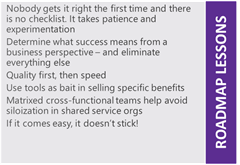
You can tell we’re making progress by listening to people’s conversations – it’s no longer about testing dates or coverage percentages or how many bugs we found this month, but “how soon can we get this into production?” – most of the fear is gone of a buggy release as we’ve moved up that quality curve. But it has been a gradual thing. I talked to everyone I could think of at conferences, about their experiences with DevOps. It took a lot of trial and error to find out what works with our organization. No one that I know of has hit on the magical formula right off the bat; it takes patience and a lot of experimentation.

Start With Testing

Our first effort was to target testing – automated testing, in our case using HP’s UFT and Quality Center platform. But there never was an all-hands-on-deck, call to “Do DevOps!” – that did happen, but it came two years later. We had to lay down the groundwork by focusing first on quality, specifically testing.

We’re five years along now and we are making progress, but don’t kid yourself that growth or a change in mindset happens overnight. Just the phrase “Shift Left” for example – we did shift our quality work earlier in the development process by moving to unit testing and away from UI/Regression testing. We found that it decreased our bugs in production by a very significant amount.

We went through a few phases – one where we had a small army of contractors doing test automation and regression testing against the UI layer. Quality didn’t improve, because of the he-said/she-said type interactions between the developers and QA teams in their different siloes. We tried to address interactions between different applications and systems with integration testing, and again found little value. The software was just too complex. Then we reached a point where we realized the whole dynamic needed to be rethought.

So, we broke up the QA org in its entirety, and assigned QA testers on each of our agile teams and said – you guys will sink or swim as a team. Our success with regression testing went up dramatically, once we could write tests along with the software as it was being developed.  Once a team is accountable for their quality, they find a way of making it happen.

We got resistance and kickback from the developers, which was a little surprising. There was a lot of complaint when we first started requiring developers to write unit tests along with their code of it not being “value added” type activity. But we knew this was something that was necessary – without unit tests, by the time we knew there was a problem in integration or functional testing, it would often be too late to fix it in time before it went out the door.

So, we held the line and now those teams that have a comprehensive unit testing suite are seeing very few errors being released to production.  At this point, those teams won’t give up unit testing because it’s so valuable to them.

“Shift Left” doesn’t mean throwing out all your integration and regression testing. You still need to do a little testing to make sure the user experience isn’t broken. “Shift Left” means test earlier in the process, but in my mind it also means that “our team” owns our quality.

Culture and Energy are the Limiting Points

If you want to “Do DevOps” as a solo individual, you’ll fail.   You need other experts around you to share the load and provide ideas and help.  A group is stronger than any individual.

Can I say – the tool is not the problem, ever? It’s always culture and energy. What I seem to find is, we can make progress in any area that I or another DevOps expert can personally inject some energy into. If I’m visible, if I talk to people, if I can build a compelling storyline – we make rapid progress. Without it, we don’t. It’s almost like starting a fire – you can’t just crumple up some newspaper, dump some kindling on it, light a match and walk away. You’ve got to tend it, constantly add material or blow on it to get something going.

We’re spread very thin; energy and time are limited, and without injecting energy things just don’t happen. That’s a very common story – it’s not that we’re lazy, or bad, or stupid – we work very hard, but there’s so much work to be done we can’t spare the cycles to look at how we’re going about things. Sometimes, you need an outside perspective to provide that new idea, or show a different way.

Lead By Listening

One of the base principles of DevOps is to find your area of pain and devote cycles into automating it. That removes a lot of waste, human defects, errors when you’re running a deployment. But that doesn’t resonate when I work with a team that’s new to DevOps. I don’t walk in there with a stone tablet of commandments, “here’s what you should do to do DevOps”. That’s a huge turn-off.

Instead, I start by listening. I talk to each team ask them how they go about their work, what they do, how they do it. Once we find out how things are working, we can also identify some problems – then we can come in and we can talk about how automation can address that problem in a way that’s specific to that team, how DevOps can make their world better. They see a better future and they can go after it.

Tools as an Incentive

I just said the tool isn’t the problem, but that doesn’t mean it’s not a critical part of the solution. I’m a techie at heart and I like a shiny new tool just as much as the next person. You can use tools as incentives to get new changes rolling. It’s a tough sell to walk into a meeting and pitch unit testing as a cure to quality issues if they take a long time to write. But if we talk about using Visual Studio Enterprise and how it makes unit tests simple and it’s able to run them real time, now it becomes easier to do unit testing than to test the old way. If we can show how these tools can shrink testing to be an afterthought instead of a week, now we have your attention!

About a year ago, our CIO set a mandate for the entire organization to excel at both DevOps and Agile. But the architecture wasn’t defined, no tools were specified. Which is terrific – DevOps and Agile is just a way of improving what we can do for the business. We now see different teams having different tech stacks and some variation in the tools based on what their pain point is and what their customers are needing.  As a rule, we encourage alignment where it makes sense around either a technology stack or with a common leader. That provides enough alignment that teams can learn from each other and yet look for better ways of solving their issues.

The rule is that each main group in IT should favor a toolchain, but should choose software architecture that fits their business needs.  In one area, for example, the focus is on getting changes into production as fast as possible. This is the cutting edge of the blade, so automation and fast turnaround cycles are everything. For them, microservices are a terrific option and the way that their development happens – it fits the business outcomes they want.

Do You Need the Cloud?

They’ll tell you that DevOps means the cloud; you can’t do it without rapid provisioning which means scalable architecture and massive cloud-based datacenters. But we’re almost 100% on-prem. For us, we need to keep our software, especially R&D, privately hosted. That hasn’t slowed us down much.   It would certainly be more convenient to have cloud-based data centers and rapid provisioning, but it’s not required by any means.

Metrics We Care About

We focus on two things – lead time (or cycle time in the industry) and production impact. We want to know the impact in terms of lost opportunity – when the fab slows down or stops because of a change or problem. That resonates very well with management, it’s something everyone can understand.

But I tell people to be careful about metrics. It’s easy to fall in love with a metric and push it to the point of absurdity! I’ve don’t this several times. We’ve dabbled in tracking defects, bug counts, code coverage, volume of unit testing, number of regression tests – and all of them have a dark side or poor behavior that is encouraged. Just for example, let’s say we are tracking and displaying volume of regression tests. Suddenly, rather than creating a single test that makes sense, you start to see tests getting chopped up into dozens of tests with one step in them so the team can hit a volume metric. With bug counts – developers can classify them as misunderstood requirement rather than admitting something was an actual bug. When we went after code coverage, one developer wrote a unit test that would bring the entire module of code under test and ran that as one gigantic block to hit their numbers.

We’ve decided to keep it simple – we’re only going to track these 2 things – cycle time and production impact – and the teams can talk individually in their retrospectives about how good or bad their quality really is. The team level is also where we can make the most impact on quality.

I’ve learned a lot about metrics over the years from Bob Lewis’ IS Survivor columns.  Chief among those lessons is to be very, very careful about the conversation you have with every metric.  You should determine what success looks like, and then generate a metric that gives you a view of how your team is working.  All subsequent conversations should be around “if we’re being successful” and not “are we achieving the metric.”   The worst thing that can happen is that I got what I measured.

PMO Resistance

Sometimes we see some resistance from the BSA/PM layer. That’s usually because we’re leading with our left foot – the right way is to talk about outcomes. What if we could get code out the door faster, with a happier team, with less time testing, with less bugs? When we lead with the desired outcome, that middle layer doesn’t resist, because we’re proposing changes that will make their lives easier.

I can’t stress this enough – focus on the business outcomes you’re looking for and eliminate everything else. Only pursue a change if the outcome fits one of those business needs.

When we started this quality initiative, initially our release cycle averaged – I wish I was exaggerating – about 300 days. We would invest a huge amount of testing at every site before we would deploy. Today, we have teams with cycle times under 10 days. But that speed couldn’t happen unless our quality had gone up. We had to beef up our communication loop with the fab so if there was a problem we can stop it before it gets replicated.

The Role of Communication

You can’t overstate credibility. As we create less and less impact with changes we deploy, our relationship with our customers in the business gets better and better. Just for example, three years ago we had just gone through a disastrous communication tool patch that had grounded an entire site for hours.  We worked through the problems internally and then I came to a plant IT director a year later and told them that we thought the quality issues were taken care of and enlisted their help.

Our next deployment required 5 minutes of downtime and had limited sporadic impact.  And that’s been the last real impact we’ve had during software deployment for this tool in almost 3 years – now our deployments are automated and invisible to our users. Slowly building up that credibility and a good reputation for caring about the people you’re impacting downstream has been a big part of our effort.

Cross-Functional Teams

It’s commonly accepted that for DevOps to work you must be cross-functional. We are like many other companies in that we use a Shared Services model – we have several agile teams that include development, QA roles, an infrastructure team, and Operations which handles trouble tickets from the sites – each with their own leader. This might be a pain point in many companies, but for us it’s just how we work. We’ve learned to collaborate and share the pain so that we’re not throwing work over the fence. It’s not always perfect, but it’s very workable.

For example, in my area every week we have a recap meeting which Ops leads, where they talk about what’s been happening in production and work out solutions with the dev managers in the room. In this way the teams work together and feel each other’s pain. We’re being successful and we haven’t had to break up the company into fully cross-functional groups.

Purists might object to this – we haven’t combined Development and Operations, so can we really say that we are “doing DevOps”? If it would help us drive better business outcomes, that org reshuffling would have happened. But for us, since the focus is on business outcomes, not on who we report to, our collaboration cross team is good and getting better every day. We’re all talking the same language, and we didn’t have to reshuffle. We’re all one team. The point is to focus on the business outcomes and if you need to reorg, it will be apparent when teams talk about their pain points.

If It Comes Easy, It Doesn’t Stick

Circling back to energy – sometimes I sit in my office and wish that culture was easier to change. It’d be so great if there was a single metric we could align on, or a magical technique where I could flip a switch and everyone would get it and catch fire with enthusiasm. Unfortunately, that silver bullet doesn’t exist.

Sometimes I listen to Dave Ramsey on my way in to work – he talks about changing the family tree and getting out of debt. Something he said though resonated with me – “If it comes easy, it doesn’t stick.” If DevOps came easy for us, it wouldn’t really have the impact on our organization that we need. There’s a lot of effort, thought, suffering – pain, really – to get any kind of outcome that’s worth having.

As long as you focus on the outcome, I believe DevOps is a fantastic thing for just about any organization. But, if you view it as a recipe that you need to follow, or a checklist – you’re on the wrong track already, because you’re not thinking about outcomes. If you build from an outcome that will help your business and think backwards to the best way of reaching that outcome – then DevOps is almost guaranteed to work.

Achieving DevOps – the back story

In writing the book “Achieving DevOps“, we threw away easily as many words as we ended up keeping. I wish space would have allowed us to talk in more depth about waste, Mission Command, and some other principles that we could only skim over at best.

We talk about this in the book as well – but we’re so much in debt to the bright people out there and the lasting work they’ve done. Not all of these were directly referenced in the book, but all influenced us. We didn’t have room for them in the book, but we figure this might be a nice starting point.

In doing our research – which was something we were only able to pull away from with regret and a few sledgehammer whacks by our publisher – some books stood out as being especially amazing. These, I’ve put below with the book cover as an active hyperlink – you can go right to Amazon and buy it from there. (We don’t get paid in any way for this. It’s just to help give back a little.)

But really, the best books I’ve already talked about in my post on “Where To Start?”

OK, on to the hotlinks:

Chapter 2 – Ratcheting Change

  • [robha] – “A Counterintuitive Strategy for Building a Daily Exercise Habit”, Rob Hardy. Medium.com, 7/21/2017. https://betterhumans.coach.me/a-counterintuitive-strategy-for-building-a-lifelong-exercise-habit-13471da4e49d. A great article that first got us thinking about bright lines and activation energy.
  • [bjfth] – “Tiny Habits”, BJ Fogg, Stanford University, 1/1/2018. https://www.tinyhabits.com/
  • [bjthgs] – “Find a good spot in your life”, BJ Fogg. Stanford University, 1/1/2018. https://www.tinyhabits.com/good-spot
  • [jclat] – “Atomic Habits: An Easy & Proven Way to Build Good Habits & Break Bad Ones”, James Clear. Avery, 10/16/2018. ISBN-10: 0735211299, ISBN-13: 978-0735211292


  • [duhigg] – “The Power of Habit: Why We Do What We Do in Life and Business”, Charles Duhigg. Random House, 1/1/2014. ISBN-10: 081298160X, ISBN-13: 978-0812981605
  • [baume] – “Willpower: Rediscovering the Greatest Human Strength”, Roy Baumeister and John Tierney. Penguin Books, 8/28/2012. ISBN-10: 0143122231, ISBN-13: 978-0143122234
  • [jclub] – “Do Things You Can Sustain”, James Clear. https://jamesclear.com/upper-bound

Chapter 2 – Kanban

  • [hanselman] – “Maslow’s Hierarchy of Needs of Software Development”, Scott Hanselman. Hanselman.com, 1/8/2012. https://www.hanselman.com/blog/MaslowsHierarchyOfNeedsOfSoftwareDevelopment.aspx


  • [ferriss] – “The 4-Hour Workweek: Escape 9-5, Live Anywhere, and Join the New Rich”, Timothy Ferriss, December 2019, ISBN-10: 9780307465351, ISBN-13: 978-0307465351
  • [drift2] – My original writeup on Timothy Fenriss’ book – https://driftboatdave.com/2014/09/02/being-busy-is-a-form-of-laziness/
  • [tdoh] – “The DevOps Handbook: How to Create World-Class Agility, Reliability, and Security in Technology Organizations”, Gene Kim, Patrick Dubois, John Willis, Jez Humble. IT Revolution Press, 10/6/2016, ISBN-10: 1942788002, ISBN-13: 978-1942788003
  • [forsgren] – “Accelerate: The Science of Lean Software and DevOps: Building and Scaling High Performing Technology Organizations”, Nicole Forsgren PhD, Jez Humble, Gene Kim. IT Revolution Press, 3/27/2018. ISBN-10: 1942788339, ISBN-13: 978-1942788331

Chapter 2 – Reliability First

Chapter 3 – Continuous Integration

Chapter 3 – Shift Left on Testing

  • [dora2017] – “Annual State of DevOps Report”, unattributed author(s). Puppet Labs, 2017. https://puppetlabs.com/2017-devops-report
  • [clean] – “Clean Code: A Handbook of Agile Software Craftsmanship”, Robert C Martin. Prentice Hall, 8/11/2008. ISBN-10: 9780132350884, ISBN-13: 978-0132350884


  • [feathers] – “Working Effectively with Legacy Code”, Michael Feathers. Prentice Hall, 10/2/2004. ISBN-13: 978-0131177055, ISBN-10: 9780131177055. A true masterpiece. Most of us are not blessed with greenfield type projects; I can’t think of many people that wouldn’t benefit greatly from reading this book and understanding how to better tame that monolith looming in the background.
  • [refactmf] – “Refactoring: Improving the Design of Existing Code”, Martin Fowler. Addison-Wesley Signature Series, 11/30/2018. ISBN-10: 0134757599, ISBN-13: 978-0134757599
  • [crisp] – “Agile Testing: A Practical Guide for Testers and Agile Teams”, Lisa Crispin, Janet Gregory. Addison-Wesley Professional, 1/9/2009. ISBN-10: 9780321534460, ISBN-13: 978-0321534460
  • [crisp2] – “More Agile Testing: Learning Journeys for the Whole Team”, Lisa Crispin, Janet Gregory. Addison-Wesley Professional, 10/16/2014. ISBN-10: 9780321967053, ISBN-13: 978-0321967053
  • [14pt] – “Dr. Deming’s 14 Points for Management”, unattributed author(s). ASQ.org, https://deming.org/explore/fourteen-points
  • [forsgren] – “Accelerate: The Science of Lean Software and DevOps: Building and Scaling High Performing Technology Organizations”, Nicole Forsgren PhD, Jez Humble, Gene Kim. IT Revolution Press, 3/27/2018. ISBN-10: 1942788339, ISBN-13: 978-1942788331
  • [freem] – “Growing Object-Oriented Software, Guided by Tests”, Steve Freeman, Nat Pryce. Addison-Wesley Professional, 10/22/2009. ISBN-10: 9780321503626, ISBN-13: 978-0321503626
  • [mesz] – “xUnit Test Patterns: Refactoring Test Code”, Gerard Meszaros. Addison-Wesley, 5/31/2007. ISBN-10: 9780131495050, ISBN-13: 978-0131495050. Particularly good in its discussion about dummy objects, fake obj, stubs, spies, and mocks.
  • [dbnm] – “No more excuses”, Donovan Brown. Donovanbrown.com, 12/12/2016. http://donovanbrown.com/post/no-more-excuses. Our personal battle cry when it comes to “asking for permission” to write unit tests.
  • [cohnx] – “The Forgotten Layer of the Test Automation Pyramid”, Mike Cohn. Mountain Goat Software, 12/17/2009. https://www.mountaingoatsoftware.com/blog/the-forgotten-layer-of-the-test-automation-pyramid
  • [williams] – “The Costs and Benefits of Pair Programming”, Alistair Cockburn, Laurie Williams, 1/1/2001. https://collaboration.csc.ncsu.edu/laurie/Papers/XPSardinia.PDF
  • [gucks] – “Moving 65,000 Microsofties to DevOps on the Public Cloud”, Sam Guckenheimer, 8/3/2017. https://www.visualstudio.com/learn/moving-65000-microsofties-devops-public-cloud/
  • [shahxr] – “Shift Left to Make Testing Fast and Reliable”, Munil Shah. Microsoft Docs, 11/8/2017. https://www.visualstudio.com/learn/shift-left-make-testing-fast-reliable/. A must-read for any serious QA devotee.
  • [shahyt] – “Combining Dev and Test in the Org”, Munil Shah. YouTube, 10/24/2017. https://www.youtube.com/watch?v=tj5mfW_gtRU. Microsoft’s decision to move to a single engineering organization where testing and development are unified was a game-changer.
  • [fowlbu] – “UnitTest”, Martin Fowler. MartinFowler.com, 5/5/2014. https://martinfowler.com/bliki/UnitTest.html
  • [fowltp] – “TestPyramid”, Martin Fowler, MartinFowler.com, 5/1/2012. https://martinfowler.com/bliki/TestPyramid.html
  • [cohn] – “Testing Pyramids & Ice-Cream Cones”, Alister Scott. Watirmelon, unknown date. https://watirmelon.blog/testing-pyramids/
  • [nonderminism] – “Eradicating Non-Determinism in Tests”, Martin Fowler, 4/14/2011. https://martinfowler.com/articles/nonDeterminism.html
  • [ddt] – “Defect Driven Testing: Your Ticket Out the Door at Five O’Clock”, Jared Richardson. Dzone.com, 8/4/2010. https://dzone.com/articles/defect-driven-testing-your . Note his thoughts on combating bugs, which tend to come in clusters, with what he calls ‘testing jazz’ – thinking in riffs with dozens of tests checking an issue like invalid spaces in input.
  • [stiny] – “You Are Your Software’s Immune System!”, Matt Stine. DZone.com, 7/20/2010. https://dzone.com/articles/you-are-your-softwares-immune
  • [molteni] – “Giving Up on test-first development”, Luca Molteni. iansommerville, 3/17/2016. http://iansommerville.com/systems-software-and-technology/giving-up-on-test-first-development/ The author found TDD unsatisfying because it encouraged conservatism, focused on detail vs structure, and didn’t catch data mismatches – which he later elaborated with other weak points, including reliance on a layered architecture, agreed upon success criteria, and a controllable operating environment. We disagree with most of his objections but agree with the cautionary note that there is no single universal engineering method that works in every and all cases.
  • [martin] – “The Three Laws of TDD”, Robert Martin. ButUncleBob.com, unknown date. http://butunclebob.com/ArticleS.UncleBob.TheThreeRulesOfTdd
  • [martin3] – “When TDD doesn’t work.”, Robert Martin. The Clean Code Blog, 4/30/2014. https://8thlight.com/blog/uncle-bob/2014/04/30/When-tdd-does-not-work.html
  • [humbleobj1] – “Refactoring code that accesses external services”, Martin Fowler. MartinFowler.com, 2/17/2015. https://martinfowler.com/articles/refactoring-external-service.html A great implementation of Humble Object and refactoring based on Bounded Contexts in this article.
  • [gruvle] – “Start and Scaling Devops in the Enterprise”, Gary Gruver. BookBaby, 12/1/2016. ISBN-10: 1483583589, ISBN-13: 978-1483583587


  • [gruv] – “Leading the Transformation: Applying Agile and DevOps Principles at Scale”, Gary Gruver, Tommy Mouser. IT Revolution Press, 8/1/2015. ISBN-10: 1942788010, ISBN-13: 978-1942788010. An in depth exploration of how HP was able to pull itself out of the mud of long test cycles – even with a labyrinth of possible hardware combinations.

Chapter 3 – Definition of Done, Family Dinner Code Reviews

Chapter 4 – Blameless Postmortems

Chapter 4 – Hypothesis Driven Development

Chapter 4 – Value Stream Mapping


  • [teams] – “Team of Teams: New Rules of Engagement for a Complex World”, Stanley McChrystal. Portfolio, 5/12/2015. ISBN-10: 1591847486, ISBN-13: 978-1591847489. The second most influential book we read, besides “The Power of Habit”. Highly recommended either printed or on Audible; it’s a fast read, and amazingly insightful.
  • [ohno] – “Toyota Production System: Beyond Large-Scale Production”, Taiichi Ohno. Productivity Press; 3/1/1988, ISBN-10: 0915299143, ISBN-13: 978-0915299140
  • [shingo] – “A Study of the Toyota Production System: From an Industrial Engineering Viewpoint (Produce What Is Needed, When It’s Needed)”, Shigeo Shingo, Andrew P. Dillon. Productivity Press; 10/1/1989. ISBN-10: 9780915299171, ISBN-13: 978-0915299171
  • [popp] – “Implementing Lean Software Development: From Concept to Cash”, Mary and Tom Poppendieck. Addison-Wesley Professional, 9/17/2006. ISBN-10: 0321437381, ISBN-13: 978-0321437389
  • [jeffmu] – “The Multitasking Myth”, Jeff Atwood. Coding Horror Blog, 9/27/2006. https://blog.codinghorror.com/the-multi-tasking-myth/
  • [liker] – “The Toyota Way: 14 Management Principles from the World’s Greatest Manufacturer”, Jeffrey K. Liker, McGraw-Hill Education; 1/7/2004, ISBN-10: 0071392319, ISBN-13: 978-0071392310
  • [devcaf65] – “DevOps Cafe Episode 62 – Mary and Tom Poppendieck”, Damon Edwards, John Willis. DevOps Café, 8/16/2015. http://devopscafe.org/show/2015/8/16/devops-cafe-episode-62-mary-and-tom-poppendieck.html
  • [willis] – “DevOps Culture (Part 1)”, John Willis. IT Revolution, 5/1/2012. https://itrevolution.com/devops-culture-part-1/ This is an extremely influential blog; I found myself turning back to it many times.

Chapter 5 – Small Cross Functional Teams

  • [tdoh] – “The DevOps Handbook: How to Create World-Class Agility, Reliability, and Security in Technology Organizations”, Gene Kim, Patrick Dubois, John Willis, Jez Humble. IT Revolution Press, 10/6/2016, ISBN-10: 1942788002, ISBN-13: 978-1942788003
  • [domenic] – “Making Work Visible: Exposing Time Theft to Optimize Work & Flow”, Dominica Degrandis, 11/14/2017, IT Revolution Press; ISBN-10: 1942788150, ISBN-13: 978-1942788157
  • [mcchryst] – “Team of Teams: New Rules of Engagement for a Complex World”, Stanley McChrystal. Portfolio, 5/12/2015. ISBN-10: 1591847486, ISBN-13: 978-1591847489
  • [rother] – “Toyota Kata: Managing People for Improvement, Adaptiveness and Superior Results”, Mike Rother. McGraw-Hill Education, 8/4/2009. ISBN-10: 0071635238, ISBN-13: 978-0071635233

Chapter 5 – Configuration Management and Infrastructure as Code

  • [rbias] – “The History of Pets vs Cattle and How to Use the Analogy Properly”, Randy Bias. CloudScaling.com, 9/29/2016. http://cloudscaling.com/blog/cloud-computing/the-history-of-pets-vs-cattle/
  • [kief] – “Infrastructure as Code: Managing Servers in the Cloud”, Kief Morris. O’Reilly Media, 6/27/2016. ISBN-10: 1491924357, ISBN-13: 978-1491924358
  • [cern] -“Are your servers PETS or CATTLE?”, Simon Sharwood. The Register, 3/18/2013. https://www.theregister.co.uk/2013/03/18/servers_pets_or_cattle_cern/
  • [guckiac] – “What is Infrastructure as Code?”, Sam Guckenheimer. Microsoft Docs, 4/3/2017. https://docs.microsoft.com/en-us/azure/devops/learn/what-is-infrastructure-as-code
  • [russd] – “It Takes Dev and Ops to Make DevOps”, Russ Collier. DevOpsOnWindows.com, 7/26/2013. http://www.devopsonwindows.com/it-takes-dev-and-ops-to-make-devops/
  • [puppiac] – “Infrastructure as code”, unattributed author(s). Puppet, unknown date. https://puppet.com/solutions/infrastructure-as-code – A great overview with videos of why IAC is so important
  • [newm] “Building Microservices: Designing Fine-Grained Systems”, Sam Newman. O’Reilly Media, 2/20/2015. ISBN-10: 1491950358, ISBN-13: 978-1491950357
  • [yevg] – “Terraform: Up and Running: Writing Infrastructure as Code”, Yevgeniy Brikman. O’Reilly Media, 3/27/2017. ISBN-10: 1491977086, ISBN-13: 978-1491977088
  • [sre] – “Site Reliability Engineering: How Google Runs Production Systems”, Niall Richard Murphy, Betsy Beyer, Chris Jones, Jennifer Petoff, O’Reilly Media; 4/16/2016, ISBN-10: 149192912X, ISBN-13: 978-1491929124
  • [gruvle] – “Start and Scaling Devops in the Enterprise”, Gary Gruver. BookBaby, 12/1/2016. ISBN-10: 1483583589, ISBN-13: 978-1483583587

Chapter 5 – Security As Part of the Lifecycle

Chapter 5 – Automated Jobs and Dev Production Support

  • [maun] – “Rundeck Helps Ticketmaster Reshape Operations”, unattributed author(s). Rundeck.org, 1/1/2015. http://rundeck.org/stories/mark_maun.html – Note the strong objections by both developers and Operations (costs, risks, SOX and security compliance, straightjacketed solution sets and loss of control). This resistance dropped on both sides as a lengthy pilot period proved that runbooks provided both simplicity and auditable, repeatable, and traceable action steps that simplified troubleshooting.
  • [pagr] – “Incident Response”, unattributed author(s). PagerDuty, unknown date. https://response.pagerduty.com/ An excellent documentation hub on how to handle initial response.
  • [mulkey2] – “DevOps Cafe Episode 61 – Jody Mulkey”, John Willis, Damon Edwards. DevOps Café, 7/27/2015. http://devopscafe.org/show/2015/7/27/devops-cafe-episode-61-jody-mulkey.html
  • [newm] “Building Microservices: Designing Fine-Grained Systems”, Sam Newman. O’Reilly Media; 2/20/2015. ISBN-10: 1491950358, ISBN-13: 978-1491950357
  • [sharma] – “The DevOps Adoption Playbook: A Guide to Adopting DevOps in a Multi-Speed IT Enterprise”, Sanjeev Sharma. Wiley, 2/28/2017. ISBN-10: 9781119308744, ISBN-13: 978-1119308744
  • [gruvle] – “Start and Scaling Devops in the Enterprise”, Gary Gruver, BookBaby, 12/1/2016. ISBN-10: 1483583589, ISBN-13: 978-1483583587
  • [sre] – “Site Reliability Engineering: How Google Runs Production Systems”, Niall Richard Murphy, Betsy Beyer, Chris Jones, Jennifer Petoff, O’Reilly Media; 4/16/2016, ISBN-10: 149192912X, ISBN-13: 978-1491929124

Chapter 6 – Metrics and Monitoring

  • [babb] – “Fly-Fishin’ Fool: The Adventures, Misadventures, and Outright Idiocies of a Compulsive Angler”, James Babb. Lyons Press; 4/1/2005. ISBN-10: 1592285937, ISBN-13: 978-1592285938
  • [theart] – “The Art of Monitoring”, James Turnbull. Amazon Digital Services LLC, 6/8/2016. ASIN: B01GU387MS. Perhaps the best overall discussion we’ve seen of monitoring and a very good, explicit implementation of the ELK stack to handle aggregation and dashboarding. See my blog post for more on this outstanding work.
  • [guckenheimer2] – “Moving 65,000 Microsofties to DevOps on the Public Cloud”, Sam Guckenheimer. Microsoft Docs, 8/3/2017. https://docs.microsoft.com/en-us/azure/devops/devops-at-microsoft/moving-65000-microsofties-devops-public-cloud
  • [hawthorne] – “The Hawthorne effect”, Tom Hindle. The Economist, 11/3/2008. https://www.economist.com/news/2008/11/03/the-hawthorne-effect
  • [baer] – “How Changing One Habit Helped Quintuple Alcoa’s Income”, Drake Baer. Business Insider, 4/19/2014. https://www.businessinsider.com/how-changing-one-habit-quintupled-alcoas-income-2014-4
  • [popp4] – “DevOps Cafe Episode 62 – Mary and Tom Poppendieck”, John Willis, Damon Edwards. DevOps Café, 8/16/2015. http://devopscafe.org/show/2015/8/16/devops-cafe-episode-62-mary-and-tom-poppendieck.html


  • [visible] – “The Visible Ops Handbook: Implementing ITIL in 4 Practical and Auditable Steps”, Kevin Behr, Gene Kim, George Spafford. Information Technology Process Institute, 6/15/2005. ISBN-10: 0975568612, ISBN-13: 978-0975568613. We wish this short but powerful book was better known. Like Continuous Delivery”, it’s aged well – and most of its precepts still hold true. It resonates particularly well with IT managers and Operations staff.
  • [rayg2] – “Customer focus and making production visible with Raygun”, Damian Brady. Channel9, 2/8/2018. https://channel9.msdn.com/Shows/DevOps-Lab/Customer-focus-and-making-production-visible-with-Raygun?WT.mc_id=dlvr_twitter_ch9
  • [hubbard] – “How to Measure Anything: Finding the Value of Intangibles in Business”, Douglas Hubbard. Wiley Publishing, 3/17/2014. ISBN-10: 9781118539279, ISBN-13: 978-1118539279
  • [turnbull] – “DevOps Cafe Episode 70 – James Turnbull”, John Willis, Damon Edwards. DevOps Café, 10/26/2016. http://devopscafe.org/show/2016/10/26/devops-cafe-episode-70-james-turnbull.html
  • [cockr] – “DevOps Cafe Episode 50 – Adrian Cockcroft”, John Willis, Damon Edwards. DevOps Café, 7/22/2014. http://devopscafe.org/show/2014/7/22/devops-cafe-episode-50-adrian-cockcroft.html. I love this interview in part for Adrian calling out teams that are stuck in analysis paralysis – and the absurdity of not giving teams self-service environment provisioning. “First I ask… are you serious?”


  • [julian] – “Practical Monitoring: Effective Strategies for the Real World”, Mike Julian. O’Reilly Media, 11/23/2017. ISBN-10: 1491957352, ISBN-13: 978-1491957356. I think this may actually be a little better than “The Art of Monitoring” – though that’s also a book we loved and found value in – just because there’s less of a narrow focus on the ELK stack.
  • [habit] – “The Power of Habit: Why We Do What We Do in Life and Business”, Charles Duhigg. Random House, 1/1/2014. ISBN-10: 081298160X, ISBN-13: 978-0812981605
  • [bejtlich] – “The Practice of Network Security Monitoring: Understanding Incident Detection and Response”, Richard Bejtlich. No Starch Press, 7/15/2013. ISBN-10: 1593275099, ISBN-13: 978-1593275099

Chapter 6 – Feature Flags and Continuous Delivery

Chapter 6 – Disaster Recovery and Gamedays

  • [dyn1] – “The Dynatrace Unbreakable Pipeline in Azure DevOps and Azure? Bam!”, Abel Wang. AbelSquidHead.com, 8/3/2018. https://abelsquidhead.com/index.php/2018/08/03/the-dynatrace-unbreakable-pipeline-in-Azure DevOps-and-azure-bam/ We would have loved to have gone into much more detail around self-healing CD pipelines and especially the advances made by Dynatrace. Monitoring as Code as a concept is rapidly growing in popularity; we love the application of using automated monitoring for a more viable go/no go decision, and having monitoring (monspec) files kept in source control right next to the other infrastructure and source code of the project.
  • [dyn2] – “Unbreakable DevOps Pipeline: Shift-Left, Shift-Right & Self-Healing”, Andreas Grabner. DynaTrace, 2/9/2018. https://www.dynatrace.com/news/blog/unbreakable-devops-pipeline-shift-left-shift-right-self-healing/ A great walkthrough of implementing an unbreakable CD pipeline, in this case using AWS Lambda functions and Dynatrace. Andreas makes a great case for applying the Shift-Left movement to monitoring as code.
  • [dop65] – “DevOps Cafe Episode 65 – John interviews Damon”, John Willis, Damon Edwards. DevOps Café, 12/15/2015. http://devopscafe.org/show/2015/12/15/devops-cafe-episode-65-john-interviews-damon.html A great discussion about the antipatterns around the releases and the dangerous illusion of control that many managers suffer from. In one company, they had less than 1% of CAB submittals rejected – out of 2,000 approved. Those that were rejected often had not filled out the correct submittal form! As Damon brought out, all this activity was three degrees removed from the keyboard – those making the approvals really had very little idea of what was actually going on. [dop65]
  • [dri2] – “Monitoring, and Why It Matters To You”, Dave Harrison. driftboatdave.com, 4/4/2017. https://driftboatdave.com/2017/04/04/monitoring-and-why-it-matters-to-you/ A more complete discussion of the vicious vs virtuous cycle described in this section, along with some specific examples from Etsy’s groundbreaking work around monitoring.
  • [tdoh] – “The DevOps Handbook: How to Create World-Class Agility, Reliability, and Security in Technology Organizations”, Gene Kim, Patrick Dubois, John Willis, Jez Humble. IT Revolution Press, 10/6/2016, ISBN-10: 1942788002, ISBN-13: 978-1942788003. There’s an excellent story by Heather Mickman of Target about what it took to yank an antique process centered around what they called the TEAP-LARB form. “The surprising thing was that no one knew, outside of a vague notion that we needed some sort of governance process. Many knew that there had been some sort of disaster that could never happen again years ago, but no one could remember exactly what that disaster was.”
  • [forsgren] – “Accelerate: The Science of Lean Software and DevOps: Building and Scaling High Performing Technology Organizations”, Nicole Forsgren PhD, Jez Humble, Gene Kim. IT Revolution Press, 3/27/2018. ISBN-10: 1942788339, ISBN-13: 978-1942788331
  • [dora2017] – “Annual State of DevOps Report”, unattributed author(s). Puppet Labs, 2017. https://puppetlabs.com/2017-devops-report
  • [mcchrystal] – “Team of Teams: New Rules of Engagement for a Complex World”, Stanley McChrystal. Portfolio, 5/12/2015. ISBN-10: 1591847486, ISBN-13: 978-1591847489. The author notes that top-down decisionmaking (as with CAB meetings) has the effect of sapping firepower and initiative; this was echoed by Brian Blackman and Anne Steiner in their interviews in the Appendix section. The military has learned the limitations of higher command, and strives not to command more than is necessary or plan beyond the circumstances that can be foreseen. Orders are given that define and communicate the intent, but the execution strategy is often left up to the individual units.
  • [catafl] – “CatastrophicFailover”, Martin Fowler. MartinFowler.com, 3/7/2005. https://martinfowler.com/bliki/CatastrophicFailover.html . A vivid description of a cascading failure and the complexities associated with event-driven architectures that informed the failure Alex experienced in this section.
  • [matr] – “Making Matrixed Organizations Successful with DevOps: Tactics for Transformation in a Less Than Optimal Organization”, Gene Kim. IT Revolution DevOps Enterprise Forum 2017. https://itrevolution.com/book/making-matrixed-organizations-successful-devops/ A good discussion on how and why to form a cross-functional team, starting with the leadership level.
  • [gruvle] – “Start and Scaling Devops in the Enterprise”, Gary Gruver. BookBaby, 12/1/2016. ISBN-10: 1483583589, ISBN-13: 978-1483583587

Chapter 7 – Microservices

  • [newm] “Building Microservices: Designing Fine-Grained Systems”, Sam Newman. O’Reilly Media; 2/20/2015. ISBN-10: 1491950358, ISBN-13: 978-1491950357. SUCH a great book, definitely on my top 3 list on this subject.
  • [bbom] – “Big Ball of Mud”, Brian Foote and Joseph Yoder. University of Illinois at Urbana-Champaign, 6/26/1999. http://www.laputan.org/mud/mud.html Based on a presentation at the Fourth Conference on Patterns Languages of Programs 1997, the original and very well known “big ball of mud” paper.
  • [yarrow] – “The Org Charts Of All The Major Tech Companies”, Jay Yarrow. Business Insider, 6/29/2011, https://www.businessinsider.com/big-tech-org-charts-2011-6
  • [manu] – “The Google Doodler”, Manu Cornet. Ma.nu, 2011. http://ma.nu/about/aboutme/2013.07.15_theartofdoing_googler_doodler.pdf
  • [feathers] – “Working Effectively with Legacy Code”, Michael Feathers. Prentice Hall, 10/2/2004. ISBN-13: 978-0131177055, ISBN-10: 9780131177055
  • [fowl2] – “Microservices”, James Lewis and Martin Fowler. MartinFowler.com, 3/25/2014. https://martinfowler.com/articles/microservices.html
  • [yegge] – “Stevey’s Google Platforms Rant”, Steve Yegge. Gist.github.com, 1/11/2011. https://gist.github.com/chitchcock/1281611 – a now legendary rant about platforms by a software architect that worked early on at both Google and Amazon. Steve did NOT get fired for his little “reply all” oopsie, shockingly – which tells you a lot about the positive traits of Google’s culture right there.
  • [dign] – “Little Things Add Up”, Larry Dignan. Baseline Magazine, 10/19/2005. http://www.baselinemag.com/c/a/Projects-Management/Profiles-Lessons-From-the-Leaders-in-the-iBaselinei500/3 – “Small teams are fast… and don’t get bogged down. … each group assigned to a particular business is completely responsible for it… the team scopes the fix, designs it, builds it, implements it and monitors its ongoing use.”


  • [sfowl] – “Production-Ready Microservices: Building Standardized Systems Across an Engineering Organization”, Susan Fowler. O’Reilly, 12/1/2016. ISBN-10: 1491965975, ISBN-13: 978-1491965979. Susan points out that there’s always a balance between speed and safety; the key is to start with a clear goal in mind. Her thoughts around alerts and dashboarding are very well thought out. Even better, it hits perhaps the one true weak point of microservices right on the head; the need for governance. She found it most effective to have a direct pre-launch overview with the development team going over the design on a whiteboard; within ten minutes, it will become apparent if the solution was truly production-ready. If you have only one book to read on microservices – this is it.
  • [conw2] – “How Do Committees Invent?”, Melvin Conway. MelConway.com, 4/1/1968. http://www.melconway.com/Home/Committees_Paper.html – The original paper as submitted by Melvin Conway. Famously the Harvard Business Review rejected Melvin’s original paper due to lack of proof; Datamation ended up publishing it in April 1968, and Fred Brook’s classic book “The Mythical Man-Month” made it famous. Rarely has such a small splash made such a big ripple.
  • [nacha] – “The Influence of Organizational Structure On Software Quality: An Empirical Case Study”, Nachiappan Nagappan, Brendan Murphy, Victor Basili, and Nachi Nagappan. Microsoft Research, 1/1/2008. https://www.microsoft.com/en-us/research/publication/the-influence-of-organizational-structure-on-software-quality-an-empirical-case-study/?from=http%3A%2F%2Fresearch.microsoft.com%2Fpubs%2F70535%2Ftr-2008-11.pdf – A very nice metrics-based backup to what we read in “The Mythical Man-Month”, as shown with the troubled Windows Vista release at Microsoft. Here in a recap of that disastrous release, the researchers found that the structure of the organization was the most relevant predictor of failure-prone applications – versus traditional KPIs like churn, complexity, coverage, and bug counts. We suspect that this paper and others like it influenced the decision by Microsoft to upend the structure of their program teams for Azure DevOps and Bing.
  • [grint] – “Splitting the organization and integrating the code: Conway’s law revisited”, Rebecca Grinter, James D. Herbsleb. ACM Digital Library, 5/22/1999. https://dl.acm.org/citation.cfm?id=302455. Interestingly, while the Nachiappan study above mentioned that globally distributed teams didn’t perform worse than collocated teams, this paper says the opposite – collocated teams are better functioning than globally distributed. It turns out that when you control for team size, both are correct: the greatest limiting factor was that old enemy, communications overhead. In other words, it doesn’t seem to matter as much if a team is collocated vs distributed, as long as we cap the size to that magical 5-12 number.
  • [lightst] – “The Only Good Reason to Adopt Microservices”, Vijay Gill. LightStep.com, 7/19/2018. https://lightstep.com/blog/the-only-good-reason-to-adopt-microservices/
  • [kimbre] – “An Interview with Jez Humble on Continuous Delivery, Engineering Culture, and Making Decisions”, Kimbre Lancaster. split.io, 8/16/2018. https://www.split.io/blog/jez-humble-interview-decisions-2018/
  • [fami] – “Microservices, IoT, and Azure: Leveraging DevOps and Microservice Architecture to deliver SaaS Solutions”, Bob Familiar. Apress, 10/20/2015. ISBN-10: 9781484212769, ISBN-13: 978-1484212769. The best book we’ve seen out there on IoT in the Microsoft space, by a long shot. Bob Familiar does a terrific job of explaining IoT and microservices in context.
  • [fowl4] – “StranglerApplication”, Martin Fowler. MartinFowler.com, 6/29/2004. https://www.martinfowler.com/bliki/StranglerApplication.html
  • [narum] – “Strangler Pattern”, Masashi Narumoto and Mike Wasson. Microsoft Docs, 6/22/2014, https://docs.microsoft.com/en-us/azure/architecture/patterns/strangler A good quick overview of how we can use the strangler pattern to chip away and eventually deprecate a massive legacy app. Mike Wasson in particular may be one of the best technical writers we’ve got at Microsoft.
  • [calca] – “Building Products at SoundCloud —Part I: Dealing with the Monolith”, Phil Calcado. Soundcloud, 6/11/2014. https://developers.soundcloud.com/blog/building-products-at-soundcloud-part-1-dealing-with-the-monolith
  • [hodg1] – “Azure DevOps: From Monolith to Cloud Service”, Buck Hodges. YouTube, 10/24/2017. https://www.youtube.com/watch?v=9frodP5xLxk&feature=youtu.be A nice discussion of how Azure DevOps made the switch to microservices, including maintaining consistency between an on-premises product and the hosted multi-tenant service, how they tackled that tough backend problem, and starting over with telemetry.
  • [hodg2] – “From Monolith to Cloud Service”, Buck Hodges. Microsoft Docs, 11/8/2017. https://docs.microsoft.com/en-us/azure/devops/learn/devops-at-microsoft/monolith-cloud-service?WT.mc_id=linkedin . Starting from a position much like Ben’s team does, with a good use of version control but little else – no telemetry, no agile or scrum, no live-site support or on-call experience, Buck walks us through turning an onprem monolith into a microservice-based, cloud-native service with Azure DevOps.
  • [hodg3] – “Patterns for Resiliency in the Cloud”, Buck Hodges. Microsoft Docs, 11/8/2017. https://docs.microsoft.com/en-us/azure/devops/learn/devops-at-microsoft/patterns-resiliency-cloud . Cloud native architecture really means resilient architecture, and distributed computing makes tracking down a root cause a frustrating and sometimes multi-week endeavor – yes, even with feature flags. Buck explores the Circuit Breaker originally implemented by Netflix and how it’s used with Azure DevOps to degrade gracefully, and their use of throttling as limits are approached with SQL Xevents.
  • [evans] – “Domain-Driven Design: Tackling Complexity in the Heart of Software”, Eric Evans. Addison-Wesley Professional, 8/30/2003. ISBN-10: 0321125215, ISBN-13: 978-0321125217. This is the gold standard, and should be required reading for anyone considering microservices – or indeed just plain well-defined systems architecture.
  • [driftx] – “Practical Microservices”, Dave Harrison. driftboatdave.com, 9/7/2017. https://driftboatdave.com/2017/09/07/mtx-2017-practical-microservices-directors-cut/ . The original blog post and references that influenced this chapter.
  • [amund] – “Microservice Architecture: Aligning Principles, Practices, and Culture”, Mike Amundsen, Matt McLarty, Ronnie Mitra, Irakli Nadareishvili. O’Reilly Media, 8/5/2016. ISBN-10: 1491956259, ISBN-13: 978-1491956250. A great discussion on Domain Driven Design in chapter 5, along with a great practical breakdown of handling one workstream and defining service boundaries using DDD of a sample company.
  • [lewis] – “GOTO 2015 • How I Finally Stopped Worrying and Learnt to Love Conway’s Law”, James Lewis. GOTO 2015 Chicago conference, YouTube, 7/15/2015. https://www.youtube.com/watch?v=l1tyfb5we7I There’s a few great examples where they knew the org was not capable of the change needed – and designed a system that would fit it (square peg in square hole!) instead of dictating how the design should work in a perfect, idealistic world.
  • [shconw] – “Randy Shoup on Microservices, the Reality of Conway’s Law, and Evolutionary Architecture”, Daniel Bryant. InfoQ, 7/3/2015. https://www.infoq.com/interviews/randy-shoup-microservices Randy uses his experience from Google and eBay to talk about why monoliths aren’t necessarily as evil as we often think they are.
  • [vaugh] – “Implementing Domain-Driven Design”, Vaughn Vernon. Addison-Wesley, 2/16/2013. ISBN-10: 0321834577, ISBN-13: 978-0321834577. This is the best applied and in-depth discussion we’ve seen of Eric’s groundbreaking work around decomposition and finding domain boundaries.
  • [newmpr] – “Principles Of Microservices”, Sam Newman. YouTube, 11/1/2015, https://www.youtube.com/watch?v=PFQnNFe27kU. Sam goes through the underlying principles behind microservices, and then attempts to resolve the tension in a core issue with microservices – how independent can they truly be as part of a whole?
  • [qamr] – “Using Microservices Architecture to Break Your Vendor Lock-in”, unattributed author(s). QArea, unknown date. https://qarea.com/blog/using-microservices-architecture-to-break-your-vendor-lock-in – Google is famous for buying or relying on COTS or OS libraries – but making sure that any interactions are through a shell that they can control and modify. This article discusses the negative cycle when we overrely on vendors and how it increases the fragility of our systems – and how they have broken this vendor lockin using Golang microservices.
  • [caval] – “Our journey to microservices: mono repo vs multiple repositories”, Avi Cavale. Shippable.com, 6/2/2016. http://blog.shippable.com/our-journey-to-microservices-and-a-mono-repository Shippable started their effort with multiple repositories, and ended up making the switch over to a single repository: “The only thing you really give up with a mono repo is the ability to shut off developers from code they don’t contribute to. There should be no reason to do this in a healthy organization with the right hiring practices. Unless you’re paranoid… or named Apple.”
  • [netfl1] – “Adopting Microservices at Netflix: Lessons for Architectural Design”, Tony Mauro. Nginx.com, 2/19/2015. https://www.nginx.com/blog/microservices-at-netflix-architectural-best-practices/ – A very good overview of Adrian Cockroft’s series of talks and thinking on microservices and the lessons he learned at Netflix.
  • [goto2014] – “GOTO 2014 • Migrating to Cloud Native with Microservices”, Adrian Cockroft. YouTube, 12/15/2014. https://www.youtube.com/watch?v=DvLvHnHNT2w – the original video on Netflix and microservices that was the source for the article above.
  • [nginx2014] – “Fast Delivery”, Adrian Cockcroft. Nginx, YouTube, 12/2/2014. https://youtu.be/5qJ_BibbMLw – Adrian points out that Netflix from the beginning favored a fine-grained, loosely coupled architecture. This fed into every one of the four key capabilities Adrian finds vital to deliver at scale – allowing autonomy and the freedom to innovate and make fast decisions; getting answers using big data analytics to explore alternatives and evaluate success; relying on the cloud to remove the latency around spinning up new resources; and eliminating coordination latency by folding everyone needed to deploy and support a service into a single team.
  • [gehan] – “Want to develop great microservices? Reorganize your team”, Neil Gehani. Mesosphere, unknown date. https://techbeacon.com/want-develop-great-microservices-reorganize-your-team – He calls a cross functional delivery team of 6-12 people a “build-and-run” team, which we kind of like.
  • [kimgb] – “Going big with DevOps: How to scale for continuous delivery success”, Gene Kim. TechBeacon.com, unknown date. https://techbeacon.com/going-big-devops-how-scale-continuous-delivery-success . We love the Target story because it’s one of those inspiring dumpster-fire-to-paradise redemption accounts.
  • [brooks] – “The Mythical Man-Month: Essays on Software Engineering, Anniversary Edition”, Frederick P. Brooks Jr. Addison-Wesley Professional, 8/12/1995. ISBN-10: 9780201835953, ISBN-13: 978-0201835953

Chapter 7 – One Mission

  • [lond] – “To Build a Fire, and Other Stories”, Jack London. Reader’s Digest Association, 1/1/1994. ISBN-10: 0895775832, ISBN-13: 978-0895775832
  • [dweck] – “Mindset: The New Psychology of Success”, Carol Dweck. Random House, 2/28/2006. ISBN-10: 1400062756, ISBN-13: 978-1400062751
  • [popov] – “Fixed vs. Growth: The Two Basic Mindsets That Shape Our Lives”, Maria Popova. BrainPickings.org, 1/29/2014. https://www.brainpickings.org/2014/01/29/carol-dweck-mindset/ Love the BrainPickings site and its fabulous content.
  • [nigel2] – “Why are we all such hypocrites when it comes to DevOps?”, Nigel Kersten. SpeakerDeck, 10/17/2017. https://speakerdeck.com/nigelkersten/why-are-we-all-such-hypocrites-when-it-comes-to-devops – A great presentation by Nigel Kersten on impoverished communication. He covers optimism bias (which is more likely when you lack experience, believe you have more control/influence than you actually do, and think negative events are unlikely). I also love the point he makes on our own skewed view of others – that we often attribute other’s behavior/skillsets as unchangeable, whereas we excuse our own as being caused by external factors (traffic was terrible today, I’m at stress from home, etc)
  • [hbr] – “Up and Down the Communications Ladder”, Bruce Harriman. Harvard Business Review, 9/1/1974. https://hbr.org/1974/09/up-and-down-the-communications-ladder – The original source of the presentation by Nigel, based on a 1969 study. We’ll call out one key point – that the feedback program must not be an endcap, but product visible results.
  • [habit] – “The Power of Habit: Why We Do What We Do in Life and Business”, Charles Duhigg. Random House, 1/1/2014. ISBN-10: 081298160X, ISBN-13: 978-0812981605
  • [ohwm] – “Workplace Management”, Taiichi Ohno. McGraw-Hill Education, 12/11/2002. ISBN-10: 9780071808019, ISBN-13: 978-0071808019
  • [sharma] – “The DevOps Adoption Playbook: A Guide to Adopting DevOps in a Multi-Speed IT Enterprise”, Sanjeev Sharma. Wiley, 2/28/2017. ISBN-10: 9781119308744, ISBN-13: 978-1119308744
  • [russd] – “It Takes Dev and Ops to Make DevOps”, Russ Collier. DevOpsOnWindows.com, 7/26/2013. http://www.devopsonwindows.com/it-takes-dev-and-ops-to-make-devops/
  • [cumm2017] – “DevOpsDays Boston 2017 – KEYNOTE: Settlers of DevOps”, Rob Cummings. YouTube, 10/20/2017, https://www.youtube.com/watch?v=woSoQq3UkAc. The Boston 2017 keynote to DevOps Days, with the outstanding Settlers and Town Planners model. He dismantles the appallingly stupid Bimodal IT theory, and we love Rob’s very succinct and beautiful definitions of what DevOps is about: “I want to deliver customer value faster and more humanely.”
  • [tdoh] – “The DevOps Handbook: How to Create World-Class Agility, Reliability, and Security in Technology Organizations”, Gene Kim, Patrick Dubois, John Willis, Jez Humble. IT Revolution Press, 10/6/2016, ISBN-10: 1942788002, ISBN-13: 978-1942788003. Chapter 16 by Steve Bella and Karen Whitley Bell is outstanding as a case study of ING Netherlands; it may be the best chapter in the entire book.
  • [wardl] – “On Pioneers, Settlers, Town Planners and Theft”, Simon Wardley. Gardeviance.org, 3/13/2015. https://blog.gardeviance.org/2015/03/on-pioneers-settlers-town-planners-and.html – The original source of the now famous three-phase DevOps growth model.
  • [teams] – “Team of Teams: New Rules of Engagement for a Complex World”, Stanley McChrystal. Portfolio, 5/12/2015. ISBN-10: 1591847486, ISBN-13: 978-1591847489


  • [lean] – “Lean Enterprise: How High Performance Organizations Innovate at Scale”, Jez Humble, Joanne Molesky, Barry O’Reilly. O’Reilly Media, 1/3/2015. ISBN-10: 1449368425, ISBN-13: 978-1449368425. For large enterprises attempting big-picture changes, this is the best book out there that we’ve found to date. Very pragmatic, numbers-centric and a huge influence on the contents of this book.
  • [bung] – “Mission Command: An Organizational Model for Our Time”, Stephen Bungay. Harvard Business Review, 11/2/2010. https://hbr.org/2010/11/mission-command-an-organizat Mission Command embraces a conception of leadership which unsentimentally places human beings at its center.
  • [reine] – “The Principles of Product Development Flow: Second Generation Lean Product Development”, Donald Reinertsen. Celeritas Publishing, 1/1/2009. ISBN-10: 1935401009, ISBN-13: 978-1935401001
  • [kimbg] “The Other Side of Innovation: Solving the Execution Challenge”, Vijay Govindarajan, Chris Trimble. Harvard Business Review, 9/2/2010. ISBN-10: 1422166961, ISBN-13: 978-1422166963
  • [perkin] – “Structuring for Change: The Dual Operating System”, Neil Perkin. Medium.com, 4/11/2017. https://medium.com/building-the-agile-business/structuring-for-change-the-dual-operating-system-78fa3a3d3da3
  • [kotte] – “Accelerate: Building Strategic Agility for a Faster-Moving World”, John P. Kotter. Harvard Business Review Press, 4/8/2014. ISBN-10: 1625271743, ISBN-13: 978-1625271747. Kotter describes here what we now call a “virtual” cross functional team, which he calls a ‘dual operating system’ – combining the entrepreneurial capability of a network with the organizational efficiency of traditional pyramid-like hierarchy, and argues that one compliments the other.
  • [dam41] – “You Can’t Change Culture, But You Can Change Behavior, and Behavior Becomes Culture”, Damon Edwards. DevOpsDays.org, Vimeo, 10/10/2012. http://vimeo.com/51120539 . An awesome discussion on culture change and how our behavior – and the standards we set – causes ripple effects.
  • [sagat] – “Why DevOps Matters: Practical Insights on Managing Complex & Continuous Change”, unattributed author(s). Saugatuck Technology, 10/1/2014. http://aka.ms/os09me A Microsoft-sponsored study that has some nice data driven insights.
  • [eliz] – “Change Agents of Ops: What it Takes”, Eliza Earnshaw. Puppet, 11/6/2014. http://puppetlabs.com/blog/change-agents-it-operations-what-it-takes A very punchy interview with Sam Eaton, the director of engineering operations at Yelp.
  • [kimx] – “How do we Better Sell DevOps?”, Gene Kim. DevOpsDays.org, Vimeo, 5/6/2013. http://vimeo.com/65548399 – A great presentation, describing the business benefits derived from DevOps.
  • [chamor] – “4 Ways to Create a Learning Culture on Your Team”, Tomas Chamorro-Premuzic, Josh Bersin. Harvard Business Review, 7/12/2018. https://hbr.org/2018/07/4-ways-to-create-a-learning-culture-on-your-team – Covers how leaders shouldn’t wait or be dependent on employer-provided training, but instead lead by example in demonstrating curiosity and sharing learning; reinforce positive learning behavior (including providing meaningful critical feedback), and looking for hungry minds in your interviewing process.
  • [woodw] – “Moving 65,000 Microsofties to DevOps with Visual Studio Team Services”, Martin Woodward, https://youtu.be/W6dqrvb-Yyw?t=4391. A fuller walkthrough of the Azure DevOps team’s transformation, start to finish.
  • [dora2017] – “Annual State of DevOps Report”, unattributed author(s). Puppet Labs, 2017. https://puppetlabs.com/2017-devops-report
  • [dora2018] – “Annual State of DevOps Report”, unattributed author(s). Puppet Labs, 2018. https://puppetlabs.com/2018-devops-report
  • [kissl2] – “Transforming to a Culture of Continuous Improvement”, Courtney Kissler, DevOps Enterprise Summit 2014 presentation, https://www.youtube.com/watch?v=0ZAcsrZBSlo
  • [forsgren] – “Accelerate: The Science of Lean Software and DevOps: Building and Scaling High Performing Technology Organizations”, Nicole Forsgren PhD, Jez Humble, Gene Kim. IT Revolution Press, 3/27/2018. ISBN-10: 1942788339, ISBN-13: 978-1942788331. We particularly enjoyed the introduction by Courtney Kissler.
  • [nflpd] – “Adopting Microservices at Netflix: Lessons for Team and Process Design”, Tony Mauro. Nginx, 3/10/2015. https://www.nginx.com/blog/adopting-microservices-at-netflix-lessons-for-team-and-process-design/ A very good article, covering Netflix’s use of the OODA loop in optimizing for speed versus efficiency, and creating a high-freedom, high-responsibility culture with less process.
  • [walkr] – “Resilience Thinking: Sustaining Ecosystems and People in a Changing World”, Brian Walker, David Salt. Island Press, 8/22/2006. ISBN-10: 9781597260930, ISBN-13: 978-1597260930
  • [doj1] – “DevOps Dojo”, unattributed author(s). Chef, 4/10/2018. https://blog.chef.io/2018/04/10/fulfilling-the-need-for-continuous-improvement-with-devops-dojos/
  • [targy3] – “DevOps At Target: Year 3”, Heather Mickman. IT Revolution, YouTube, 11/28/2016. https://www.youtube.com/watch?v=1FMktLCYukQ&app=desktop Heather describes the storming/norming/performing process we’ve seen elsewhere with successful DevOps initiatives – starting in 2012, with change agents appearing and kickstarting a grassroots DevOps transformation; then a gradual uplift as senior leaders took up the torch and provided the muscle and focus needed to build out better architecture.
  • [damb] – “Target CIO explains how DevOps took root inside the retail giant”, Damon Brown. EnterprisersProject.com, 1/16/2017. https://enterprisersproject.com/article/2017/1/target-cio-explains-how-devops-took-root-inside-retail-giant More on Target’s use of DevOps Dojos to overcome hurdles, from the CIO directly.
  • [rach] – “Target Rebuilds its Engineering Culture, Moves to DevOps”, Rachael King. Wall Street Journal, 10/19/2015. https://blogs.wsj.com/cio/2015/10/19/target-rebuilds-its-engineering-culture-moves-to-devops/ The subject of the Dojo keeps coming up as a critical catalyst in the Target use case.
  • [eliz] – “DevOps and Change Agents: Common Themes”, Eliza Earnshaw. Puppet, 12/3/2014. https://puppet.com/blog/devops-and-change-agents-common-themes
  • [srew] – “The Site Reliability Workbook”, Betsy Beyer, Niall Richard Murphy, David K. Rensin, Kent Kawahara, and Stephen Thorne. A terrific resource, especially the discussion in Chapter 6 on toil.
  • [schauso] – “Sharing our experience of self-organizing teams”, Willy Schaub. Microsoft Developer Blog, 12/2/2016. https://blogs.msdn.microsoft.com/visualstudioalmrangers/2016/12/02/sharing-our-experience-of-self-organizing-teams/ This and Brian Harry’s article below describe one of the most innovative – and insane-sounding! – team building exercises that ended up being much less disruptive, and wildly successful, than Microsoft first thought.
  • [bharryso] – “Self forming teams at scale”, Brian Harry. Microsoft Developer Blog, 7/24/2015. https://blogs.msdn.microsoft.com/bharry/2015/07/24/self-forming-teams-at-scale/
  • [bjaaso] – “Agile principles in practice”, Aaron Bjork. Microsoft Docs, 5/30/2018. https://docs.microsoft.com/en-us/azure/devops/learn/devops-at-microsoft/agile-principles-in-practice

Chapter 7 – DevOps and Leadership

Chapter 8 – The End of the Beginning

  • [lewpm] – “Project management non-best-practices”, Bob Lewis. InfoWorld, 9/26/2006. https://www.infoworld.com/article/2636977/techology-business/project-management-non-best-practices.html
  • [mezak] – “The Origins of DevOps: What’s in a Name?”, Steve Mezak. DevOps.com, 1/25/2018. https://devops.com/the-origins-of-devops-whats-in-a-name/ A nice overview of the beginnings of the DevOps movement, including the seminal presentations given in 2008 and 2009 by Andrew Schafer, Patrick Debois, John Allspaw, and Paul Hammond.
  • [net] – New English Translation of Ecclesiastes 3:22. NET Bible Noteless, Kindle edition, 8/26/2005. ASIN: B0010XIA8K
  • [shunryu] – “Zen Mind, Beginner’s Mind: Informal Talks on Zen Meditation and Practice”, Shunryu Suzuki. Shambhala Library, 10/10/2006. ISBN-10: 9781590302675, ISBN-13: 978-1590302675

Appendix – Aaron Bjork

  • [bjork] – “Agile At Microsoft”, Aaron Bjork. Microsoft Visual Studio, YouTube, 10/2/2017. https://www.youtube.com/watch?v=-LvCJpnNljU This is the best explanation I’ve seen of “The Microsoft Story”, and it’s packed with information; a must-watch.
  • [wang2] – “VSLive! Keynote: Abel Wang Details Microsoft’s Painful DevOps Journey”, Abel Wang. Visual Studio Magazine, 8/17/2018. https://visualstudiomagazine.com/articles/2018/08/17/abel-wang-devops.aspx. There’s a great snapshot and explanation of the bug cap in this article, as well as other background behind the MS story.

Appendix – Betsy Beyer, Stephen Thorne

  • [sre] – “Site Reliability Engineering: How Google Runs Production Systems”, Betsy Beyer, Chris Jones, Jennifer Petoff, Niall Richard Murphy. O’Reilly Media, 4/1/2016. ISBN-10: 9781491929124, ISBN- 13: 978-1491929124
  • [ghbsre] – “The Site Reliability Workbook: Practical Ways to Implement SRE”, Niall Murphy, David Rensin, Betsy Beyer, Kent Kawahara, Stephen Thorne. O’Reilly Media, 8/1/2018. ISBN-10: 1492029505, ISBN-13: 978-1492029502
  • [kieran] – “Managing Misfortune for Best Results”, Kieran Barry. SREcon EMEA, 8/30/2018. https://www.usenix.org/node/218852 . This is a great overview of the Wheel of Misfortune exercises in simulating outages for training, and some antipatterns to avoid.

Appendix – John-Daniel Trask

Appendix – John Weers

  • [issurv] – IS Survivor, Bob Lewis. http://issurvivor.com/ . This is a great site John recommended that we enjoyed very much, especially on process and change management.

Appendix – Rob England

Appendix – Sam Guckenheimer

Connect KeyNote with Brian Harry. Devops Projects – awesome scaffolding for your release management project!

Still going through videos from Connect, there’s a lot of stuff to wade through! Definitely enjoyed Brian Harry’s keynote address – especially the awesome Abel Wang helping out as copresenter. Here’s my notes.

The takeaway stuff is this –

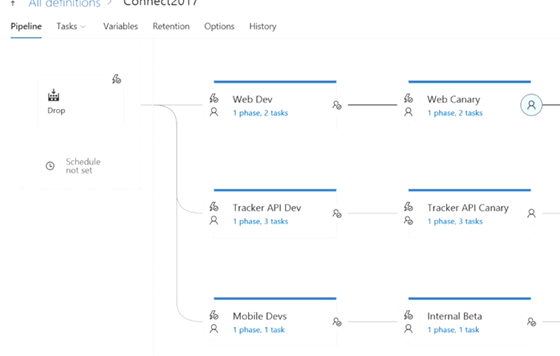
  1. you can use Azure DevOps Projects to create a fully functional CI/CD pipeline as a starting point to any project, then extend it. This is way cool and I can’t believe it hasn’t existed before. The release visualizations are definitely top knotch.
  2. YAML is now supported. (Several of my customers have been asking about this!)
  3. There’s some real goodies here about how Microsoft handles its releases – hint its not Dev-> Prod with one click, using scale units.
  4. Automated gateways are now possible in VSTS. This is definitely a huge win…

In more detail:

  • (roughly 1 min in) – Food for thought: “DevOps is all about shortening feedback lops… automated deployments are often the first thing we think about.” There’s a lot of plumbing though – it can be daunting.
  • (minutes into broadcast) 4:30 – Azure DevOps Projects- easily create a full end to end RM pipeline, using Node.Js, .Net, Java, PHP, Python.
  • 5:59 – dashboarding – click on links for code / build/dev pipeline. To customize, clone it onto your HD – delete all files, copy in your code, then push it back to VSTS using Git. Easy!

  • 13:44 – YAML support now included in our CI system
  • 14:41 – No one actually pushes a button and code goes out the door to production – “I call that the fastest way of deploying bugs to your customers.” At Microsoft we have 15-20 different scale units (subsets of customers). We use Release Management to gradually roll these out across environments. First we roll out to one scale unit, watch twitter for sentiment downturns, check feedback, use it – etc. Then we wait 24 hours before deploying to the next ring. That’s responsible CI/CD. If we have a blocking bug – we pull the cord and roll back.
  • 23:00 – demo of build agents running natively on all 3 platforms – Win/Linux/Mac. You could use one release to all 3 environments if you wanted to. I thought this was amazing:

  • 26:18 – automated gate creation. These are automatically created post deployment monitors – using Azure monitor, functions, REST API, and service bus to stress test/check your new system’s health.

  • 27:48 – creating a YAML build
  • 32:27 – fork into private repo vs a branch.


For a full writeup including a new walkthrough on Azure DevOps Projects, click here. There’s a quickstart here.

Full list of Connect DevOps vids and my writeups: (this will grow)


DevOps – how we do it at Microsoft, with Aaron Bjork.

Two great interviews I found today and enjoyed very much, between Donovan Brown and Aaron Bjork (who is head of the DevOps part of VSTS).

From the first video:

  • We treat our development teams as adults – “I’ll trust you until you give me reason not to.”
  • How does Microsoft structure their product teams?
  • How do we keep to a consistent UI? i.e. checkboxes versus radio buttons – what design guidelines do we use?
  • How to tie together 50 teams with one weekly meeting of six people
  • How big of an advantage it is to dogfood it – be your own first customer.
  • “Our engineers write code, test code, and deploy code.”
  • Feature flags – we don’t use these for just one customer. The boundary to turn on the flag is during the current sprint, and then turn off the following sprint.

Second video notes:

  • (minutes into program) 1:27 – Why 3 week sprints? Goldilocks principle. Donovan mentions a physician product owner where 4 weeks was the best he could get.
  • 5:46 – Dogfooding, and customer driven features.
  • 13:09 – We used to have all these plans that helped me sleep at night – but did we ever ship on time? (i.e. waterfall and requirements planning as a security blanket)
  • 16:32 – importance of monitoring. DevOps is not automation. Most of their DevOps discussions end with Agile.
  • 19:03 – distrust between Dev and Ops. The chasm grows. Now we are improving with TDD, unit testing – but the distrust is still there.
  • 20:27 – treat your deployment pipeline as a feature of your product.
  • 27:54 – Do we deliver mid-sprint at Msft?
  • 32:57 – “You can’t cheat shipping.” Scenarios, features, stories and tasks.
  • 39:10 – Feature flag litter and documentation.

DevOps – are you stuck on where to start? Building out 4 Release Pipelines in an Hour with Donovan Brown

Such, SUCH a great treat having Donovan come all the way from Houston for this presentation. He’s a fantastic presenter and his hands-on knowledge blows my socks off. I can’t thank him enough for making the trip.

IF YOU ATTENDED and you enjoyed the presentation – or even if you didn’t enjoy it – WE NEED YOUR HELP!
Take a few minutes and click on this link – it will tell us how we can improve next time, and hopefully lay the groundwork for Donovan to come back in a year or so.

There’s a streaming video available here of Donovan’s Portland Area .NET User Group (PADNUG) presentation. It was outstanding! If you want to see one CI/CD release pipeline built out releasing a website to Azure in one hour – well sorry, that is not what he did. Instead, Donovan built out FOUR pipelines in an hour – using Node.js, Java, .Net and .Net Core., while describing step by step what he was doing and why – using VSTS, the Azure Portal, Visual Studio, and a cool command-line tool I hadn’t heard about called Yo Team!

The key takeaways from his presentation are as follows:

  • If you only get one thing from our time together – Microsoft is for any language, any platform.
  • Licensing costs should not be a blocker for us. It’s like $10/person per month, and that’s only for large teams over 5. And with MSDN you get these benefits included.
  • Lastly, if you attended and enjoyed the presentation – give a shout out to Donovan on Twitter. He’s thrown down the gauntlet – “we have the best build and release tools on the market, if you don’t agree reach out to me on Twitter and be specific!” So, if you don’t think Microsoft’s build tools will work with Jenkins, or Java apps, Node.js, SonarQube etc – throw down and enter the squared circle my man!

My notes are below. These aren’t notes of his presentation as they were no-slide demos, but comments Donovan made during the day that gives DevOps context to his presentation. As the saying goes, “If I had more time it would have been shorter!”


Thoughts on Strategy

Make incremental changes in ramping up your maturity. It’s safer. If you are deploying manually, there’s one part that you fear the most. Focus on that.

“If it hurts, do it more often.” (You are incurring more risk by deploying less frequently.) Lean forward into that and think about, how can I fix this. Focus on scariest part first.

If you need prescriptive – hire a consultant. (Like, I don’t know, Microsoft Premier for Developers maybe!) They can ask questions, pinpoint pain points for your org and provide a specific roadmap.

Why do you have to ask permission from your manager? Your job as an engineer is to continuously deliver value. You should need to ask permission if you DON’T want to set up CI. No need to stop and learn for months – focus on what hurts the most, and focus on that one thing. What is the thing – every time you run a deployment – why it breaks. Otherwise – you end up paying a tax doing it manually. Find something small to focus on – don’t try to do it all at once. It might take you months – after which you may have an amazing portion of your pipeline that was manual that is now automated. That will get people excited. And after that last build that blows up when people start playing the “Not it” game – guess what, you get to go home early!

And if you’re stuck on exactly where do we start? – http://donovanbrown.com/post/How-do-we-get-started-with-DevOps (really, check this post out. It’s good enough to mention twice!)


Agile Is Your Starting Place

The key question is – “Can you produce releasable bits of code?” Until your Agile processes are strong – not perfect but mature – you can’t see significant gains with DevOps. The business needs to understand that we need to produce increments of shippable code. DevOps is the “second decade of Agile.” Once Agile is in place you will realize that you’re not able to ship as fast as you can produce features.

What limits us so far – four years after “The Phoenix Project?” Really it’s still slowed by adoption of Agile. 40% of orgs have adopted Aguke. That’s a dead number, as its only dev teams that are championing this. The rest of the org is expecting waterfall, requirements, dates.

DBA’s are frequent blocking point. If you slice vertically and not horizontally. I’ll give you 3 months, if you promise not to make any further changes to the schema, ever. “That’s crazy!” “If you’re going to change it anyway why should I invest 3 months in this now. Your first step could start with login functionality – in 3 weeks we have a login page, username and credentials, authentication and identification.” Don’t let a recalcitrant DBA stop you in your tracks.

One week sprints really worked well (at one company) for Donovan in his consulting past- with product owner/business owner. After 8 weeks, needed to get a knowledgeable person (replacing old business owner) – and a sigh of relief, finally back on track. And hire a scrum master. That person needs to be able to say no to the boss. For a good product owner, all they have to do is understand the business they are trying to serve – and tell me of two backlog items which one is a priority. Scrum Masters must protect team from unrealistic expectations, on this date, I want these features – perfect quality. Quality is not negotiable – either move date or lose features.


Database Goodies

SQL Server Data Tools (SSDT) – version every object on SQL Server including permissions and roles. Stored in a database project. (this is free. Evaluate, see if it meets your need.) An amazing tool, been around for 10 years, very little known – our best kept secret! If SSDT for some reason isn’t scaling or working for you – ReadyRoll from RedGate is also a good option.


Last but not least – this amazing site brought to my attention from Jorge Segarra. An awesome resource for all things DevOps for you DBA guys! https://www.microsoft.com/en-us/sql-server/developer-get-started/sql-devops/

This may require breaking up into diff schemas (like a virtual namespace) vs one huge project. Schemas are here now and available; will allow you to segment databases that you create – no 3000 tables/etc in one untranslatable blob. (BACPAC is schema and data, DACPAC is just schema. Can run post/pre scripts- make sure its idempotent so if it runs twice you don’t double your db size!)

Migrating your CRUD statements from sprocs to Entity Framework may be a win to move away from thousands of unwieldy and clunky INS/UPD/Del type statements.


Integration Testing (Selenium etc)

DevOps – one company said “DevOps = Automation”. So they had thousands unit and integration tests. Code would flow with no human intervention from commit to production. As soon as they release a CSS change though to prod, they start losing money. As soon as they started looking at ecommerce website – summary page made final buttons and the text the same color- this resulted in a blank button! Automation clicked it because the ID of the button did not change. So, automate everything you CAN – don’t try to automate things you shouldn’t.

Best practices for building integration tests: the #1 thing is making sure assumptions you made when you recorded your automation are still valid. Usually the database in QA is the failing point: the code isn’t broken but the data it runs against doesn’t fit assumptions. See Redgate’s excellent tool SqlClone here.) They are a few versions behind with their Selenium driver, using IE.

“We spend more and more time with peer testing than we do with auto testing on the Microsoft VS team. As we’re our own first customer, there’s a lot of A/B testing that happens. Integration testing happens very little, unless there’s a performance issue – then we move it to GoBig environment where we can perf test.” Per Brian Harry – “Unapologetically we do testing in production.”

Donovan ran a team in Akron where they were not allowed to write a line of code until they wrote a UI test (in CodedUI, but now we do this in Selenium). They wrote automation before they wrote code – wrote so it fails, then refine until it passes. This and a manual test case – which can be given to a stakeholder in plain English (“oh, I didn’t expect I should be pressing that button”) – there’s nothing better than a manual test case to be your new acceptance criteria. Automation and UI tests are brittle – they become brittle/break, that didn’t go away, but having it there forced my teams to do the right thing early. (These were one week sprints, Weds to Weds.) Do it more often if it hurts! Finding clever ways of making BACPAC/data layer work.

VS teams – forced them to move more functionality to behind the scenes, UI testing. Make unit testing viable. To those nerd architects out there claiming that “Unit tests are worthless”! – we run 41000 unit tests in VSTS and it takes 6 minutes. You can’t run integration tests that fast.


Infrastructure as Code (ARM templates) and Configuration Management (PowerShell DSC)

ARM (Azure Resource Manager) is the name of the game here to get Infrastructure as Code working. This is a much better process than spinning up resources manually for example. (Not configuration here – doesn’t include IIS, etc. )

Recommendation: Introduce your Infra team to ARM templates. ARM templates are Azure only but you can use Terraform to point to Azure/multi-cloud solution so you can move resources to Google/AWS etc.

Configuration as Code – using PowerShell DSC (Desired State Configuration) – take configuration of that server and you codify it as well. (I demand you have port 80 open, .NET 4.5, IIS available, these security roles etc.) Server installs everything you need to bring it to ready state. Every 15 minutes – checks to make sure it fits standard config. So, if it finds that IIS is turned off, it will detect if the configuration is drifting and make a note in the log. You can also configure it to bring it back to standard state.

PowerShell DSC works for both Linux and Windows environments. And, it’s free! (p.s. Chef uses DSC as well so it’s a layer on top of a layer.)

Recommendation: Start with what you have and what’s free with PowerShell DSC and THEN make an evaluation if there’s features that are missing. This could take <1 hour. From Donovan – “I encourage you to ping me on Twitter if DSC is not getting the job done. If we can’t fix it fast enough, then go to Chef or a competitor.”

DSC can be done onprem/etc. It’s idempotent, which means you can run it blindly a million times in a row and the server will stay exactly the way it needs to.


Self Service VM’s with Dev/Test Labs

Struggling with self service VM’s and exposing costs of resources to the consumers you service? (I.E. that 5 9’s coming at a horrendous price that is shielded from end users/business?) Think about Dev/Test Lab. This is Self service – no blank check, you can spin up a sandbox (using allocated $ your customers buy each month) and enforces the VM images they are allowed to spin up.

Dev/Test Lab documentation – https://docs.microsoft.com/en-us/azure/devtest-lab/

Overview and trial site hub – https://azure.microsoft.com/en-us/services/devtest-lab/

Starting documentation, very good – https://docs.microsoft.com/en-us/azure/devtest-lab/devtest-lab-overview


Microservices

Of advantage because releases now are micro sizes. No more having to track down 6 months back with a dictionary of changes. Would eliminate webmethods – ESB. Can rev very quickly on microservices without jeopardizing the application as its very small, atomic pieces of functionality.

Meant to be combined with containers.

Not a silver bullet. Evaluate it. Microsoft is going there on VSTS team. Docker support is built into VSTS – can publish to a registry. Even TFS 2015 update 3-4 has Docker support as well. Need to also run Win Server 2016 to support containers, or Linux containers. Anniversary edition of Windows 10.