Author: elvisboats

Short Version: I'm married to the amazing (and amazingly forgiving) Jennifer, proud possessor of two amazing kids, crazy about all things trouty with fly fishing. I'm an Application Development Manager with Microsoft, and am based out of Portland, Oregon. Long Version: I grew up in Oregon, and moved down to California with the original goal of finishing my education in Civil Engineering, but I found application development and RDBMS systems much more exciting! I do miss the mountain biking in California and the awesome Mexican food, but Oregon is my home and I have never regretted moving back to start a family. Plus it gives me more time for fly fishing for trout and steelhead on the beautiful Deschutes river in central Oregon! ;-) Working for Microsoft has by far been the best experience of my professional life; it's great working with a group of people that are passionate about writing good code and continually improving development practices and firepower. Past assignments have included Providence Health Plans, Kroger, and managing a .NET development team at Columbia Sportswear. Working at Columbia in particular gave me a great customer-side perspective on the advantages that Azure offers a fast-moving development team, the dos and don’ts of agile development/scrum, and the cool rich Ux experiences that SPAs (Single Page Applications) can offer with Breeze, OData, WebAPI, and modern Javascript libraries. Microsoft did a fantastic job of engaging with Columbia and understanding our background and needs; I witnessed their teams win over an initially hostile and change-averse culture. The end result was a very satisfying and mutually beneficial partnership that allowed Columbia to build dynamic applications and services using best-of-breed architecture. I’m a MCDBA and a Certified Scrum Master.

Thriving in a time of change

I’ve been thinking a lot about fear lately.

I have a very good entrepreneur friend who tells me he’s laying off many of his developers. There’s just no need for them anymore – AI is simply put doing a better job of it. In fact, you can try it yourself – go to Lovable.dev, and ask it to “create a landing page for my website on all things golden retrievers”. About 90 seconds later, there’s your website – mostly functional, just a few tweaks left. AI is a very powerful tool, one that I now find I can’t live without in my daily life. It’s chilling to think that these LLM’s are progressing to the point where they can produce code, document, find defects, and design systems architecture almost instantly – and as good (sometimes better) than I can. And it’s getting better every day.

Is it ok for me to say that this fills me with fear? What will happen to my family and I if I have to change careers? I’ve been in software development all my life. What if that, very suddenly, just goes away?

Unfortunately I have no crystal ball and I don’t know where my industry will be in five years. I do think about my girls, both 17 years old and starting to make their own way in the world. I have no idea on how to best direct them in terms of their career. It seems very likely that they will spend their twenties and thirties as I did, trying new things and failing, getting up and starting over.

So my wife and I are trying to teach them qualities that will help them succeed. Maybe we don’t know what kind of work they’ll be doing. But I can teach them how to work – that never changes. Things like how to take direction. How to actively listen. How to not make your boss’ life difficult. Being humble. Working hard, with purpose.

Listening to some of my colleagues talk about their fears this week had me thinking about what qualities I will need in the years ahead to adapt and be resilient. Here’s my thoughts:
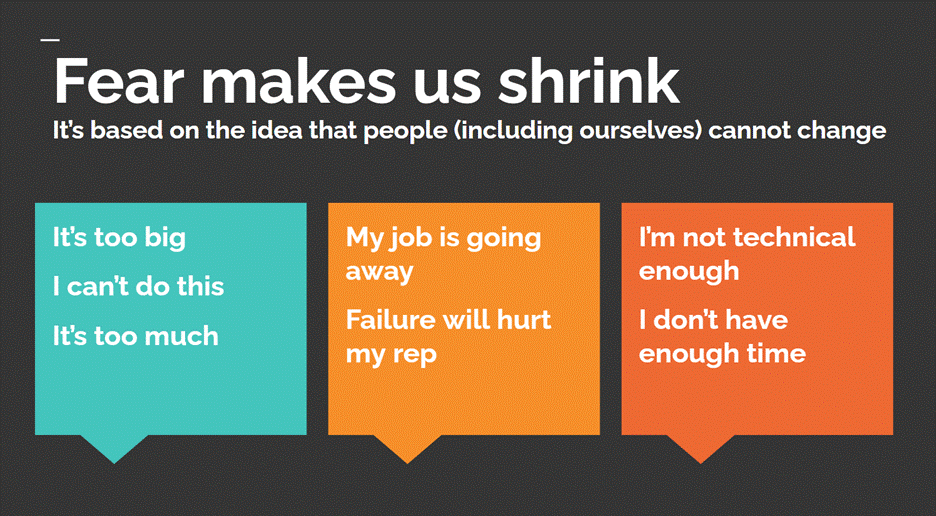
Every lie we tell ourselves comes with a short term benefit and a long term cost. In this case, the belief that we are past the age where we can change – I am what I am – is the greatest limiter at all. It’s comforting though, and that’s the short term payoff. This is who I am. I’m a victim of events beyond my control. I’ve never been able to do that successfully. That’s just not my forte.

Thoughts like this are comforting, in a weird way, because it promises familiarity, stability. I don’t have to change. The long term cost is – we have stopped learning, adapting. The world is changing – we are trying to stay the same. So we say things like “it’s too big” / “it’s too much”, “I don’t have the time”, “I’m just not a technical person”, etc.

Here I’m indebted to the book “Tiny Habits“, by BJ Fogg. Famously, he would do a few pushups after every time he went to the bathroom. Over time, and we’re talking months / years, he would ramp up the number of pushups. Guess what happened over time with his personal fitness level, from that really small incremental effort?

This really helped me when I found out I had diabetes. After spending some months being totally overwhelmed with the huge changes I had to make, I read this book. I remember closing it and saying to myself, I am the type of person that goes to the gym every day. So I changed that one thing, as a daily habit. Sometimes I would go to the gym and barely show up – like I’d put on my gym shoes and maybe walk for a few minutes. But I would show up. It made a world of difference in my health.

The point of this book, to me, is that big all-out efforts, like that New Year’s Resolution to drop 20 lbs in three months, almost always fail. It’s just too much change, too fast. But incremental, small changes in my habits – like reducing and then cutting out alcohol, or going to the gym – always win, if you stick with it.

The same thing was true when I wrote my book. I called my shot – started telling people, I’m an author. I’m in the middle of writing a book, it will be out in June. I can guarantee you, if I had not have put myself out there like that, the book would never have been written.

So what does this have to do with our mindset during times of epochal change like this one?

Bear with me a bit here. The five qualities above are each worth a blog article of their own. But short and sweet – if we accept that life is impermanent and constantly in flux, and we ourselves are constantly changing with it – then we are capable of adapting to anything, can learn and master ANYTHING we put our minds to. That’s an incredibly empowering thought. In fact, if we have a specific goal we want to accomplish – say, writing a book, or learning the piano, or getting more healthy physically – we can build a little habit and grow it steadily over time to reach that goal. And because we’re trying to learn like children do – without ego, without fear of failure, playing with new things and having fun – growth comes naturally. We’re learning from failure, and we’re persistent, because we have a clear goal and a solid plan. There’ll be days where we can do little or nothing, but we’re not going to burn out – because we forgive ourselves and realize plateaus are a part of life.

The fact is that AI is here to stay and it’s a disruptive change. It’s a threat, no question – but it’s also an opportunity. This is a great time to move away from the employee mindset, and think about creativity – making something new, something distinctively YOURS. AI and large language models are amazing tools, and they’re going to empower us to be creative and do meaningful, high impact work in ways we can’t even imagine. And the best part is, this field is brand new. The barriers will never be lower than this, the frameworks are still taking shape and will never be easier to adopt. So this is the perfect time to try something new in an exciting field where there’s nothing but upside. I can create and make art in my own way in this space, this month.

What new things will you try or learn about this month? I’m excited to find out!

“Hands On Kubernetes” – first thoughts

So these are my first thoughts on the Hands on Kubernetes book by Nills Franssens et al…

It’s a solid book! I enjoyed especially the first chapter where it’s setting the stage for the demos / hands on work in the following chapters. Obviously there’s been some new additions in what capabilities Azure Kubernetes Service (AKS) has to offer since, which I’ll try to explain.

In chapter 2, the book asks you to create a new AKS cluster using the Azure Portal. THis could be done with CLI, ARM, or Terraform of course… The new thing here is the ability to create a cluster with Azure Arc. That allows you to use things like Azure Policy and Azure Monitor to control / observe your containers when you’re running them onprem (say using VMWare vSphere or Azure Stack HCl), or using Google Cloud or AWS. For now though we’ll just create a straight up cluster:

… which once you’re done with all the options should take about 5 minutes or so, on US West 3 region. A few notes here – you’re going to NOT want to set up Availability Zones (of course you would do this for a prod workload), and you want a STANDARD setup of 2 nodes (not Dev/Test, which would normally be the best pick) – because we’re going to want to experiment with Azure Monitor to check our observability. The AKS pricing tier you want is “free”, and the node count range is a new option – select “2-5”.

A quick snapshot of the bare bones setup we’re using here:

When that AKS cluster is finished being spun up, you’ll see something like the following:

What happened here exactly though? Select “Go to resource” – and you’ll be able to inspect what was created. For example, the Resources section shows any running deployments / pods, and it’s where you create new resources. In the Node pools, you can scale up/down by adding nodes – and add a new node pool, potentially even with a different (beefed up) VM size. In the Cluster config page, you can upgrade the control plane – and then the individual node pools in a followup step. This is also where you’d enable RBAC or integrate with Azure AD.

Insights though is where we can actually view the cluster’s utilization and how it performs under load:

From here it’s a walk in the park. You COULD download from GitHub the source materials for the book. I found selecting the quick start application gave me a very nice starting point… a simple Voting app that’s easy to create / destroy:

The next option to play with is the last one – “Connect to cluster”. From here you’re given all the information you need to connect via Bash or Azure Cloud Shell to your newly created resources. This is where you can run some of the commands noted in the book as we’re starting to play around with cmd line explorations –

kubectl get node 

az aks get-credentials --resource-group rg-handsonaks --name handsonaks

… And that’s it for now. You can easily go into the control panel again and remove the entire resource group to bring yourself back to a clean start state.

Closing Thoughts and Next Up

I feel like here’s a good point though to talk about the WHY of things… Software development seems to be making these leaps forward about every decade. In the early 2000’s, the big change took the form of a pattern and a practice – the pattern being Scrum and Agile, the technology / process taking the form of source control. Skip forward another 10 years, to say about 2014, and the leap forward was DevOps. Again this change becomes a pattern (Infra as Code), and a practice (CI/CD, and config mgmt)… The upcoming change seems to still be taking shape, but the 2020’s definitely seem to be the era when the pattern of microservices is achieving dominance – with the tech behind this being Kubernetes and Docker. The stuff we used to hear about “microservices only being for the large enterprises” or “Kubernetes isn’t meant for production workloads” is just not holding any water – it’s FUD.

Other things I want to play with down the road:

Monitoring What Matters – John-Daniel Trask of Raygun

I had a great talk recently with one of my favorite peeps – John-Daniel Trask, CEO of Raygun. We talk about the importance of monitoring and making that connection with the customer experience, and what he’s seen go right – and wrong – in working with companies large and small. We’re huge fans of Raygun and see this company’s growth as a natural byproduct of producing the right product that reinforces all the behaviors we want out of the DevOps movement. Enjoy!

I always enjoy talking with John-Daniel and he was a big factor in monitoring and metrics taking up so much room in my book. Here’s some of the topics we cover:

  • How to aggregate errors so you don’t feel like you’re putting out a tire fire with a water pistol
  • Best practices around real user monitoring, crash monitoring and APM
  • First things first; why crash reporting should be the first thing you port out
  • How John-Daniel is adjusting to life as a new father (welcome Henry!) and what it was like growing a global business as a young entrepreneur
  • How Google changed the game around how responsive and user-centric websites and services are
  • A fact we often forget: software is written ultimately for humans. “Software gives us the power to amplify human ability.”
  • Another great all-time quote, from his mentor: “It’s not the big that eats the small, it’s the fast that eats the slow.”

One last great quote to end on: “DevOps is about making engineering teams as reliably fast as possible.”


A link to the interview is here – and it’s on the podcast platform of your choice. AppleGoogleSpotify, blah blah…. We’re on all the major platforms now, including AnchorAppleGoogleSpotifyPocketCasts, and RadioPublic. Please support the podcast, and we’d love to hear your feedback about the book!

Enjoy the podcast!


LaunchDarkly and feature flags

Had a friend ask me for some videos around Feature Flags. There’s no shame in admitting that I’m a huge fan of feature flags; it seems like one of those no-brainers when it comes to making releases faster and safer. Without them, I’m not sure how close we can possibly get to true “continuous delivery” even for smaller sized projects.

As I think some of you might be interested as well – here’s some videos and web references below. I hope to expand on this with some more in-depth demos down the road. This is going to come across like I’m shilling for LaunchDarkly. (In all fairness, I’m not the only person at MSFT that loves them.)  But when it comes to FF I’m not sure if there’s another vendor in that space that offers what they do.

And some more references from my book:

  • [harris] – “Using feature flags in your app release management strategy”, Richard Harris. App Developer Magazine, 4/19/2018. 

Four questions around testing and Microsoft’s progress with DevOps

I was at a conference earlier this week and we got some outstanding questions about how Microsoft went about their transformation – especially with the Azure DevOps team. I want to build on this with a followup post going into more depth on our use of culture and automation – but here’s a good place to start with some great links.

Question #1 – How do we handle planning on a strategic level with the more tactical focus of Agile?


Question #2 – How did Microsoft go about their transformation to DevOps from a shared services model?


Question #3 – What about testing? (This is usually one of our biggest blockers to improve release reliability and velocity – an unreliable, flaky test layer)

Question #4 – Production Support. Let’s say we have an Agile team, 8-12 people. How the heck are we supposed to do global support across multiple regions, 24x7x365 in production?

  • Short answer – the only way this will work is if you 1) make sure you’re only supporting a small sliver of functionality, 2) that you gate the support demands upon your devs so it’s <50% of their time i.e. the SRE model. More than likely you’re going to have some operational support – even offshore or 3rd party – handled externally to the team. 3) alerts are tuned so that only truly important things make it through. I talk about this extensively in my book; the books “The Art of Monitoring” and “Practical Monitoring” also elaborate on this.